Chinese weddings in New York
A Chinese wedding in New York often holds two weddings in one day: the tea ceremony, where the couple honor their parents and elders, and the Western ceremony and banquet that follow. We have planned Chinese weddings with traditional tea ceremonies and a lion dance, and we plan them with you from the first meeting, and with the people who keep the traditions where that helps. Every wedding keeps them a little differently, and we ask before we assume.

How we weave the tea ceremony into the day
The tea ceremony is the heart of the day for many couples. The couple serve tea to their parents, grandparents and elder relatives, in order of seniority, and receive their blessings, often with red envelopes or gold jewelry in return. The tea is usually sweetened, sometimes with red dates or lotus seeds, for a sweet marriage.
Where it sits in the day is the first decision. Some families hold it in the morning at home or in a suite, before the Western ceremony. Others hold it at the venue, in a private room during cocktail hour. Each changes the timeline, the attire and the photographs. Our tea ceremony guide sets out the options.
- 9:30 amThe groom’s party arrives for the door games, if the family keeps them.
- 10:30 amThe tea ceremony, the groom’s family first or the bride’s, as you decide, in a room set for it.
- 12:00 pmA break, a meal and the change into the Western wedding dress.
- 4:30 pmThe Western ceremony.
- 7:00 pmThe banquet, with the lion dance to open it and a change into a qipao or qun kwa before the toasts.
Honoring the tradition
We plan the tea ceremony with you, and with the parents where they lead it, often before we plan anything else: who is served, in which order, who pours, who sits, what is said. We prepare a written order of greetings, so no aunt or grandparent is missed, and we set a room where the elders are comfortable, with chairs placed and time to rest.
Seating at the banquet is planned the same way, with the elders honored and both sides mixed as you wish. When grandparents are flying in, we plan their day separately: when they arrive, where they rest, who sits with them, and when they may want to leave.
Attire changes, planned
Many brides wear three looks in the day: a qipao or qun kwa for the tea ceremony, a Western gown for the ceremony, and another qipao or an evening dress for the banquet. Each change needs a room, a dresser, and time in the timeline, never taken from the guests’ evening.
Design with meaning
Red and gold carry meaning, and so do double happiness characters, peonies and the number eight. We use them with intention, where they matter to you, and design the rest of the day around your own taste rather than a set of symbols. A red envelope box can be a piece of the design rather than an afterthought on a side table, and a tea set can be chosen as carefully as the china for dinner.
The lion dance
A lion dance brings luck and noise, and it needs space, a clear path and a moment in the evening that suits it. At Blue Hill at Stone Barns, lion dancers opened the reception. We brief the troupe, the venue and the kitchen together, so the drums arrive when the room is ready for them.
Weddings we have planned with these traditions
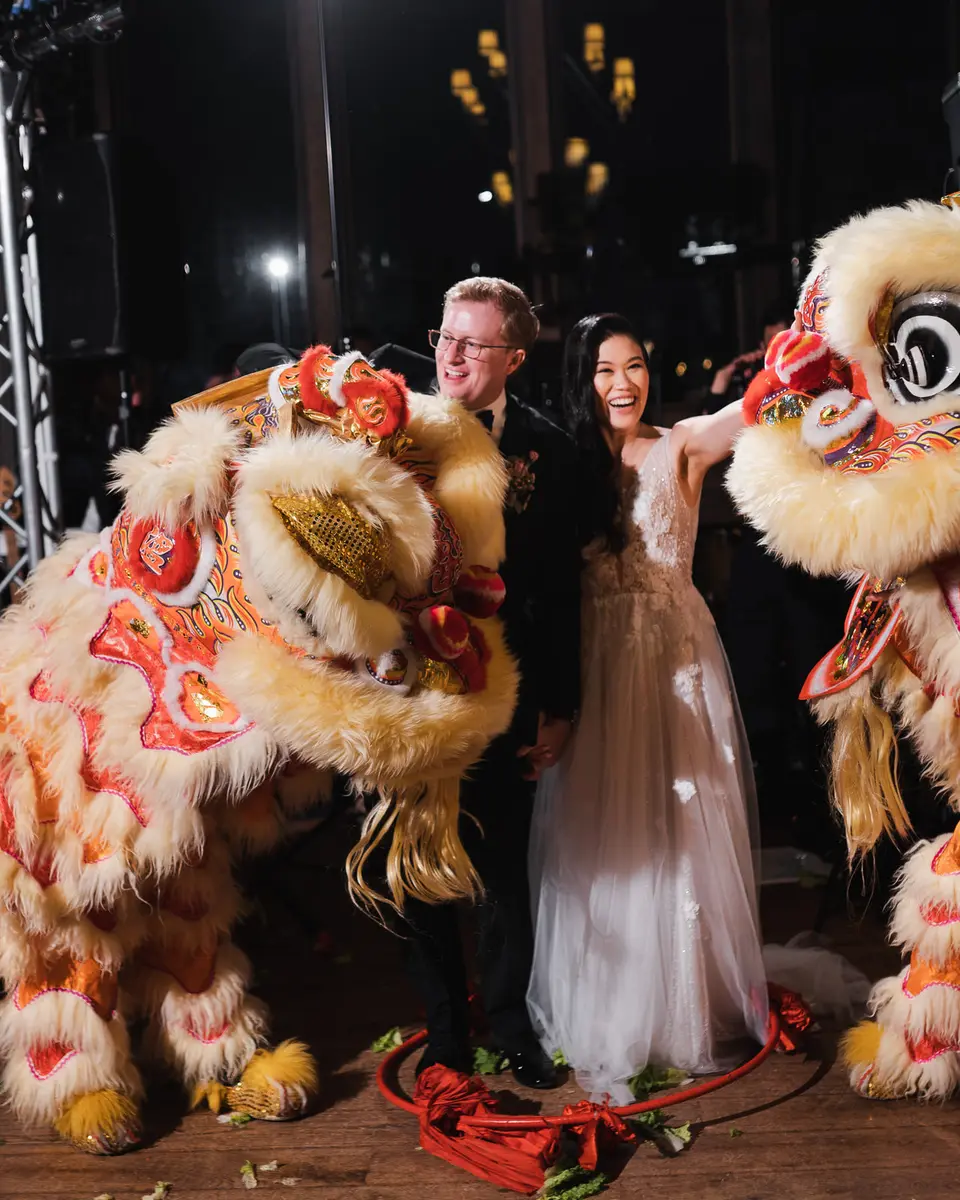
Amy & David’s Blue Hill at Stone Barns wedding
A tea ceremony and a lion dance around a farm dinner. Blue Hill at Stone Barns, Westchester.

Venues that suit a Chinese wedding
- Blue Hill at Stone Barns
Pocantico Hills, Westchester
Where we planned a tea ceremony and a lion dance around a farm dinner.
- The Yale Club of New York City
Vanderbilt Avenue, Midtown Manhattan
Private rooms of several sizes beside the ballroom, so the tea ceremony can take place in quiet while guests gather for cocktails.
- The Rockleigh
Rockleigh, New Jersey
Room for a large banquet and a ballroom that takes a design at scale.
Questions couples ask
Do you plan Chinese tea ceremonies?
Yes. We have planned traditional tea ceremonies, among them at Blue Hill at Stone Barns, where the day also held a lion dance.
When should the tea ceremony take place?
In the morning before the Western ceremony, or at the venue during cocktail hour. Both work. The choice depends on the attire, the room and how many relatives are served.
How long does a tea ceremony take?
Usually between thirty minutes and an hour, depending on how many relatives are served. We time it with you in advance.
Can you arrange a lion dance?
Yes. We have planned a lion dance at Blue Hill at Stone Barns, and we work with the troupe, the venue and the kitchen on timing and space.
Do you work with couples and families in China, Hong Kong or Taiwan?
Yes. We plan with couples and families wherever they live, by video at hours that suit them and on the channel they use, WeChat and WhatsApp included. See our international families page.
Tell us about the traditions you will keep.
Tell us about your wedding, and we will take it from there.